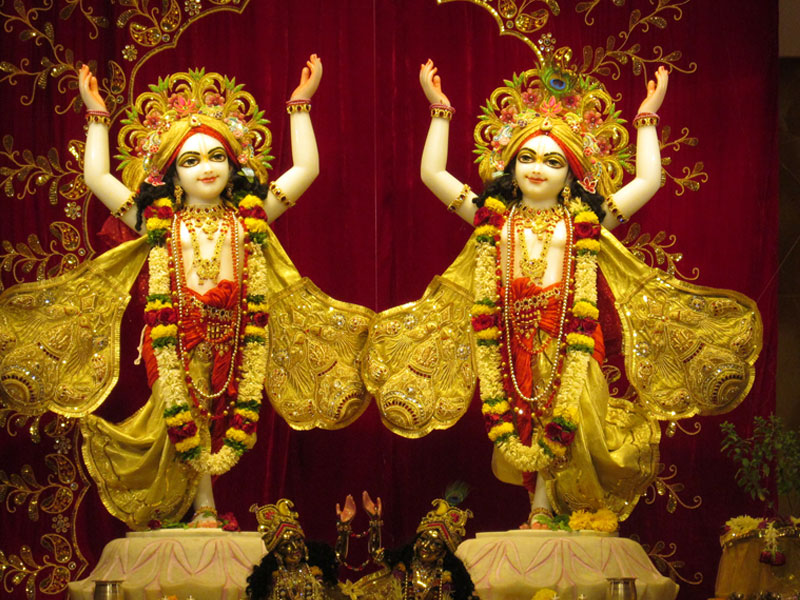
The inner fire of discipline that purifies the heart and deepens one's connection to Krishna โ the foundation upon which all service rests.
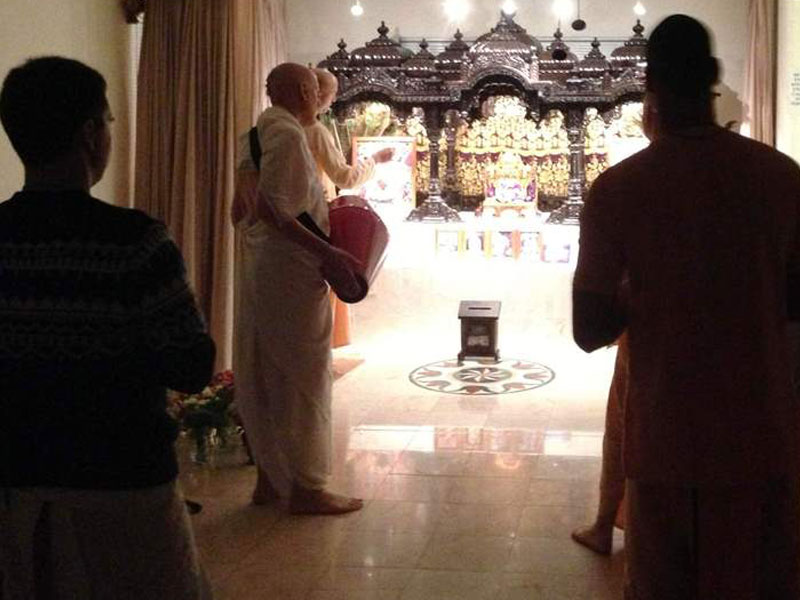
For over five decades, Tamohara Dasa has maintained a daily spiritual practice of extraordinary consistency. His day begins in the brahma-muhurta โ the auspicious hours before dawn โ with mangala-arati, the first worship of the Lord. This is followed by the chanting of the Hare Krishna maha-mantra on tulasi beads, a practice he has sustained without interruption since 1972.
His sixteen rounds of japa each day โ a minimum commitment of approximately two hours of focused meditation โ form the bedrock of his spiritual life. He has often spoken about how this daily practice of the Holy Name sustains him through the challenges of administrative service, the demands of travel, and the complexities of organizational leadership.
At the heart of Vaishnava austerity are the four regulative principles that Srila Prabhupada prescribed for all initiated devotees: no meat-eating, no intoxication, no illicit sex, and no gambling. These are not mere rules of denial but acts of liberation โ freeing the consciousness from the heaviest modes of material entanglement so that the soul can turn toward Krishna.
Tamohara Dasa has followed these principles with unwavering fidelity for over fifty years. He teaches that true austerity is not about suffering but about choosing reality over illusion, choosing the eternal over the temporary. In his lectures, he explains how each principle corresponds to freedom from one of the four pillars of sinful life, creating the foundation of a clear, peaceful, and devotionally oriented consciousness.
Tamohara Dasa has made numerous pilgrimages to the most sacred sites of Gaudiya Vaishnavism. Vrindavan, the eternal home of Lord Krishna, holds a special place in his heart. He has spent extended periods there โ sometimes weeks at a time โ immersed in the atmosphere where every grain of dust is considered more valuable than the most precious gem.
His pilgrimages to Mayapur, the birthplace of Sri Chaitanya Mahaprabhu and the global headquarters of ISKCON, connect him to the wellspring of the sankirtan movement. These journeys are not tourist excursions but acts of deep spiritual renewal, where the accumulated dust of material engagement is washed away by the mercy of the holy dhama.
True leadership, Tamohara Dasa teaches, is itself a form of tapasya โ demanding patience, humility, and the willingness to put the needs of others before one's own.
Managing a diverse region with complex interpersonal dynamics requires extraordinary patience. Tamohara Dasa has navigated organizational crises, personality conflicts, and institutional challenges with a calm steadiness that devotees attribute to his deep sadhana and unwavering faith in Krishna's plan.
Despite his academic credentials and organizational authority, Tamohara Dasa maintains a life of remarkable simplicity. His personal needs are few, his possessions minimal. This simplicity is not performative but the natural expression of a consciousness focused on things that are permanent, valuable, and connected to Krishna.
The austerity of maintaining one's principles when it is inconvenient โ when compromise would be easier, when silence would be safer โ is perhaps the most demanding form of tapasya. Tamohara Dasa has consistently chosen the path of scriptural integrity, even when it placed him against popular opinion.
"Austerity is not about making ourselves uncomfortable. It is about refusing to be comfortable in illusion. When we say no to temporary pleasures, we say yes to the eternal joy that Krishna offers. That exchange is not sacrifice โ it is the greatest bargain in the universe."